Monday, March 12, 2007

Eating Jesus

Osutein-Sensei & the Body of Christ

We here at Jack Black's Body are admittedly a bit too enamored with Jables' corporeal visage.

But let's be fair— our little obsession is nothing compared to the worldwide fixation with the body of that other righteous revolutionary. The one whose first name starts with "J" and whose last name starts with a letter between "A" and "D." That’s right, I’m talking about Jesus.

For those of you not in the know, Jesus was a Palestinian Jew who was born, coincidentally enough, exactly 2,007 years ago. Jesus’ mother was a virgin and his father was a carpenter from the sticks. He was born in a barn. When he was about thirty years old, Jesus quit his dad's furniture business and started stickin' it to the Man 24/7. In Jesus’ time, the Pharisees were “the Man.” They were the Pat Robertsons of their day, only with beards and shiny robes.

Jesus nearly incited a revolution when he went around saying stuff like "God loves everyone," "give to charity," and "please don't throw rocks at hookers." This did not sit well with the Man, so the Pharisees turned him over to the Romans (those dudes from Gladiator) who, because they apparently loved ironic deaths, nailed the former carpenter to a couple of two-by-fours.

It’s been a while since the Pharisees ruled the mount. These days, Jesus is pretty popular. The world's two billion Christians worship him as the Son of God, while another billion Muslims venerate him as one of the most important Prophets. Everyone else regards him as a holy man or a visionary moral philosopher.

Really—except for angsty white high school students reading Beyond Good and Evil for the second time—pretty much the only thing everyone around the world can agree on is that yeah, that Jesus guy was pretty rockin'.

Despite Jesus’ obvious power to bring on the rock, he remains controversial. Or rather, his remains remain controversial. One of the biggest splits between Muslims and Christians isn't Jesus’ moral teachings—they all agree on that. It's whether or not he died on the cross. Christians say yes, he died for our sins. Muslims say no, he ascended into heaven and an imposter died on the cross.

The conflict is even more extreme between the factions of Christianity. Major wars have been fought over what percentage of Jesus was divine and what percentage was human. For more than a thousand years, Europe and the Middle East were torn asunder by armies running back and forth, killing each other over theological gimmicks.

The fact that Jesus was pretty firmly against killing people seemed lost on those shedding blood in his name.

No one cared about Jesus’ ideas. It was his Body they cared about—what it was made of, what it did, where to find part of it. Religious folk from cathedrals all over Europe hunted for relics to attract pilgrims and sell postcards. One cathedral in Italy even claimed to have found the foreskin of Jesus. Ew.

Of course, even today the strange obsession with Jesus’ Body continues. Christians are so into it that they’ve made a ritual out of it. They eat bread that symbolizes his body and drink wine that represents his blood.

Catholics and Protestants have spent the better part of five hundred years arguing about whether the bread is just Jesus’ Symbolic Body (Protestants) or Jesus’ Transubstantiated Body (Catholics). Either way, what's not to love about a religion that makes cannibalism and vampirism central to its practice?

That's not the only controversy surrounding Jesus’ Body, of course. The DaVinci Code and the upcoming James Cameron documentary about the alleged discovery of the Christ Family Tomb in Jerusalem have sparked debate over whether or not Jesus got hitched and pumped out a couple of holy ankle biters.

Let's hope not.

While Jesus would doubtless be the perfect father, I imagine being his kid would kinda suck. Everyone would expect you to be perfect and Christmas would just be your dad's birthday, among other traumas ("Pack your bags, kids, we're going to Grandpa's house." "NOOO!! I DON'T WANNA DIE!!!")

Outside of the Judeo-Christian-Islamic World, this controversy seems a little silly. A number of my Japanese friends saw The DaVinci Code. (Reason: the Japanese love two things above all else: mullets and Tom Hanks. Tom Hanks with a mullet? Nirvana.) After the movie, they all said to me, "It was interesting, but I'm confused. Why does it matter if Jesus had a kid or not?"

I tried to explain the historical and theological reasons, the Christian distrust of sex and Jesus’ supposed divine perfection... but ultimately I agree with them.

Why did it matter what Jesus did with his Body? Weren't Jesus’ teachings the big draw? Y'know, love God, love your neighbor, turn the other cheek, don't judge, wash your feet.

I feel like we're missing the point. Remember, Jesus wanted us to stop throwing rocks at hookers, not throwing rocks at each other over whether or not Jesus married a hooker.

Labels:


Read more!

Monday, February 05, 2007

The Room Without A Country

Osutein-Sensei Uses His Imagination (And Guns)


My International Relations textbooks defined nation-states as "imaginary entities," in the sense that they exist only because we all agree that they exist. This makes me sad. I have been left out of these planet-wide meetings for my entire life. I've always wanted to sit around with billions of other people and then, at the prompting of some mysterious voice, agree that "Yes, we would still like to have Canada around. It will be big, and snowy, and a little too obsessed with hockey. And their bacon will be different."

Those meetings sound like a lot of fun.

Of course, imagination has its drawbacks. The British and French were a little too creative with the Middle East in the early twentieth century, inventing countries that they probably shouldn't have, like Iraq. The Iraqis seem to think they were three countries, but the British had the guns, and sadly, guns beat imagination. It's like rock-paper-scissors, but with atrocities. And nothing beats guns.

A country is seen differently by different groups of people. Tsushima, the island I lived on in Japan, is a place where cultures meld and nationalities overlap. Closer to Korea than to Japan, Tsushima is definitely Japanese in culture and persuasion, but there are little traces of the Korean influence here and there. You’ll find a scattering of words in the local dialect and the ruins of a 1,400-year-old Korean castle deep in the woods.

Embassies and consulates also complicate the otherwise tidy imagination, since they are technically little pieces of one nation-state in another nation-state's imaginary territory. I work for the Japanese consulate here in Chicago, which means that every morning I wake up in the United States, then commute to Japan. So, don't talk to me about your commute time. I don't wanna hear it.

Oddly enough, the consulate's sovereign Japanese soil is not restricted to its two floors in the Olympia Center, but extends to the three cars it owns. According to international law, the interiors of those cars are part of Japan. With all the consulate and embassy cars around the world, if you were to look at a political map of the earth you would see thousands of tiny foreign countries moving around inside each other's borders. Since the cars enjoy diplomatic immunity, most of these tiny countries are probably moving at excessive speeds or parked in front of fire hydrants.

Yet, even the most vivid national imagination can't account for the inevitable spaces in-between—hence the endless squabbling over international waters. But not all of these gaps are wide as oceans. Some are about the size of closets—like “the airlock.”

To get to my office I have to swipe my card to unlock two doors. Between the doors is a small space we jokingly call "the airlock." It's completely empty except for the keypad for the second door. The question is: If what lies behind the first door is America and what’s beyond the second door is the consulate (and thus sovereign Japanese territory), then what is the airlock? It lies outside of all national territories and jurisdictions, a 5' x 6' No Man's Land.

It's a limbo inside of which anything is legally possible, because for those brief moments when both doors are closed, a person in the airlock is untouchable. The most heinous of crimes could be committed in the airlock with impunity: murder, drug trafficking, cutting the tags off mattresses.

Until recently, that is. As of last week, the airlock is no longer a space between countries. It is a country. After taping my flag up on one of its walls, the airlock has become the Empire of Osutein, a sovereign territory populated and ruled with an iron fist by yours truly.

Before you protest or declare war, remember that it's only fair. After all those years of not being invited to the official nation-state imagination meetings, I decided that I'll have to do it on my own. You see—anything is possible if you just use your imagination... and guns.

Really, really big guns.

Labels:


Read more!

Thursday, November 09, 2006

When Geeks Were Gods


Osutein-Sensei On the University of Chicago
& the Foundations of American Football

The most exciting moment in this year's NFL season so far was the Chicago Bears miraculous come-from-behind win in the last minutes of their game against the Arizona Cardinals (as detailed earlier by Jack's Jock). While the game will go down in the records as one of football's most thrilling, what is less known to history is that both of those teams got their names from a most unlikely place: the University of Chicago.

Today the U of C is considered the nerdiest of nerd schools, the place where brilliant but pasty sun-averse students go when they're afraid of being beaten up by the hardened street thugs that attend Harvard. It is, in short, the world's most prestigious Star Trek convention. In its earliest days, however, the U of C was an athletic powerhouse that not only dominated, but partially invented, the game of American football.

Much of that invention can be credited to one man: Amos Alonzo Stagg, coach at the U of C from its founding in 1892 to 1932. Stagg was a first-rate innovator, and while the coach at Chicago he devised a number of elements that we now consider the most basic components of the game. Namely, the huddle, the lateral pass, numbering plays, the tackling dummy, and even putting players' names on the backs of their uniforms.

The University itself became a founding member of college football's most storied conference, the Big Ten. Under Stagg, Chicago rose to be one of the best teams in the country, winning seven Big Ten championships, and the national championship in 1905. Oddly enough, the U of C is the only team that remains undefeated against Notre Dame. So dominant were they, that the Chicago team was nicknamed the "Monsters of the Midway," after the Midway Plaisance that borders the campus.

Even after Stagg left Chicago in 1932, the University continued to make football history. A U of C quarterback named Jay Berwanger became not only the first man to win the Heisman Trophy in 1935, he also became the Heisman Trophy (the statue atop the award is modeled after Berwanger). Yes, every year, the NCAA honors that year's best offensive player by giving him a statue of a U of C alumn. Irony abounds.

In 1939, concerned that a sport as violent as football was incompatible with the mission of a scholarly university, the U of C football program was shut down. Stagg Field, named after the great coach, remained standing, and it was directly beneath its west stands that Enrico Fermi and other scientists ushered in the atomic age in 1944 by creating the first self-sustained atomic reaction as part of the Manhattan Project. As Kurt Vonneghut notes wryly in Time Quake, "The university considered football too violent, so they shut down the stadium and built a nuclear bomb factory instead." Irony, of the apocalyptic variety, abounds.

With its legendary football program gone, the U of C started down the long, dark road to dorkdom. Eventually, Stagg Field was torn down to make way for the university's main library, the Regenstein, arguably the epicenter for all nerdiness on earth. However, the U of C's gridiron legacy endures, both in college and pro football. Including, as I noted earlier, in the names of two NFL teams.

The Chicago Bears apparently believed the moniker "Monsters of the Midway" was too good to pass up, so they adopted it (along with the stylized "C" the U of C team had used on its helmets)—despite the fact that Soldier Field is nowhere near the Midway Plaisance. It must have been the alliteration. Whatever it was, it stuck, and the Bears have been nicknamed the "Monsters of the Midway" ever since (currently, their crushing defensive line is most often given the title).

At that time, however, Da Bears were not the only team in town. As with baseball's Cubs and White Sox, Chicago football was initially divided on a North Side/South Side line. Da Bears originally played at Wrigley while the Chicago Cardinals played to the south. The South Siders were a bit downtrodden and their first uniforms were actually old jerseys borrowed from the powerhouse college team at the University of Chicago. The jersey's official U of C maroon color had faded to cardinal red, so the coach nicknamed his team the "Chicago Cardinals." When the team moved to Arizona, they kept the name but added cardinals to their helmets, perhaps to make it look like they were named after the bird rather than poorly washed
hand-me-down laundry.

So, last month, when the Monsters of the Midway took to the field against the Cardinals, with their names on their backs, and took to huddles and threw lateral passes, it was all thanks to the U of C. And now that you know a little more about the invention of American football, will you enjoy the game that much more? Is the Heisman Trophy just a tad more meaningful? Does the Regenstein Library seem a little bit cozier? Has the U of C become just a little more hip?

Probably not.

But at least you’ve learned some great trivia to pass around at cocktail parties. And knowing trivia that is utterly trivial is something that all U of C alumns, whether the jocks of old or the nerds of now, can truly appreciate.

Labels:


Read more!

Tuesday, September 12, 2006

Returned Japanese


Osutein-Sensei: Out of Asia
(Part 2)

One of my Japanese students once asked me what I missed the most about America. I thought about my family, my friends, the deep well of American culture that had shaped my personality and world view. I missed none of these. What I really missed, truly deeply longed for in the very depths of my soul, was Chick-Fil-A.

Now, you might be wondering why I would miss a fast food chicken joint, but then you must understand that I am Southern. You see, to a Southerner Chick-Fil-A is a sacred thing, like Sunday morning church, football, sweet tea, humidity, and reducing entire sentences to monosyllables (for example, in the South "have you eaten yet?" is pronounced "jeat?")

Thus when I walked into my first Chick-Fil-A after moving back to the States, I entered starry-eyed and full of anticipation. I approached the counter, chose what delicious deep-fried morsel of obesity I was going to eat, and then... nothing. I didn't know what to do. How the hell do you order fast food in English? I thought. I timidly shuffled up to the counter, stumblingly announced I'd like a chicken sandwich, pulled out the strange green bills and oddly sized coins from my pocket and dropped it on the counter. "Don't say anything in Japanese, don't say anything in Japanese," I whispered to myself, afraid of the instinctive responses that had been drilled into my head. I backed away, accidentally bumping into the condiments stand and when my order came up, I took the tray, bowed deeply, and said "domo."

Shit.

I thought living abroad would expand my horizons and give me the confidence to do anything I set my mind to do. Instead, I can no longer function in Chick-Fil-A. Having studied esoteric book trivia in the dim, hallowed corridors of the Ivory Tower, I knew from a millenia's worth of journey narratives that "you can never go home again," much as you cannot step into the same river twice or reuse the "Buy 2 Dish Towels Get 1 Free" coupon at participating Targets. Odysseus and Leopold Bloom had taught me that much. What I didn't realize was that I would also find ordering a chicken sandwich problematic.

And there's the rub. Coming back, one expects to find everything changed (as stipulated by literature): one's son grown, one's wife cheating on you with a guy whose name is even more absurdly sublime than yours, one's Shire scoured, and the dish towel coupons hopelessly expired. Epic revelations, full of grandeur and melancholy, not fried chicken and frustration.

There's a certain joy, though, in rediscovering one's home country, of being able to see it as the rest of the world does. There's the horror, obviously, of the consumer waste, the violence, the cultural banality and nearsightedness you insisted America did not have when a Japanese co-worker asked for the hundredth time if you could in fact use chopsticks, and the fact that salads are served with bacon in bowls the size of plastic kiddie pools. But there's also the glorious chaos of so many cultures living, working, cooking, and quarreling together, the endless choice, the English language, the vastness of a continental nation, and of course, Chick-Fil-A.

I know now that I can never go back to Chick-Fil-A as I once did. But I will go back, and I will order a chicken sandwich without fear or failure. As God as my witness, I will never go hungry again.

Labels:


Read more!

Thursday, August 17, 2006

Returning Japanese

Osutein-Sensei: Out of Asia
(Part 1)
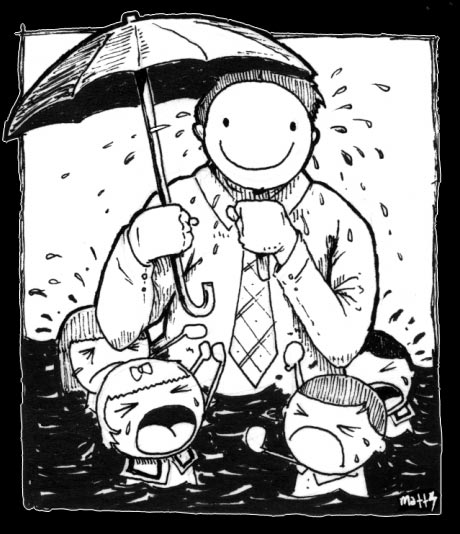
Illustration by Master Matt


The students at Kashishi Jr. High School decided I needed to cry. They were not alone in this. A good portion of my town of Toyotama, on the remote Japanese island of Tsushima where I lived and worked as an English teacher for two years, was conspiring to tear-jerk me. Perhaps part of the reason was that they had not yet seen me cry, despite what they must have considered to be ample opportunity. We often think of the Japanese as rather cold, with upper lips as stiff as samurai steel, but even the manliest man's men are reduced to blubbering in the proper setting, like graduations and good-bye parties for departing teachers. And though I was sad to say "sayonara" to students and teachers I'd befriended, my eyes always remained dry at such events.

I am, after all, an American male, and that means I am by law only allowed to cry at loved ones' funerals, when dogs die, and during cheesy, inspirational sports movies when everyone begins to slow-clap. Even had I gotten teary, there'd be no competing with the overflow of emotion around me. Being an American at a Japanese good-bye party is like being a robot in the midst of an Italian funeral.

So, Osutein-sensei had to cry. I was leaving after two years. Crying was simply called for. I nearly broke at my elementary school good-bye ceremonies, when all the adorable students I'd come to think of as my little Japanese sisters and brothers gave me hand-made gifts and messages. I held strong, though. Toyotama Elementary School would have succeeded in making my tear-ducts flow had they not used a computer to translate the big banners they made into English, "It Returns to America and It Is Not Forgetting of Enjoy Memories and We Tell It Come Back." Never before has being reduced to an anonymous, genderless pronoun been so profound.

At Kashishi, though, they had an ace up their sailor suit sleeves. While I greatly enjoyed teaching at all my schools, Kashishi was special. From my first day there, the staff and students had welcomed me and made me feel that I belonged there. They had treated me, in other words, not as the mysterious outlander, but as one of them. A lot of this was thanks to the English teachers, a woman with the wonderfully unfortunate name of Saiko (pronounced "psycho") and her eventual replacement, Mayumi, both of whom made me feel like I belonged. For an expatriate, especially in Japan, where I always stuck out like a white-skinned thumb, finding such a place is sanity-saving.

Which is all the more remarkable considering that Kashishi is a small squid fishing village at the dizzy fringes of the earth. Even in my town of 4,000 people, it was considered remote and backwards. But I belonged there, in my own strange way. It was like my Cheers, where everyone knows (or at least tries to correctly pronounce) your name. So they didn't have to try so hard to make me cry when I left, though try hard they did.

As I found out later from Mayumi, the students had gathered in secret and plotted their tear-summoning masterpiece. They took my favorite karaoke song, John Denver's "Take Me Home, Country Roads," and rewrote the lyrics to be about Tsushima. And they practiced into the long dark hours of the night (or so I like to imagine), trying to get it right. A delicate process, as one girl named Nagisa realized. "We have to sing it cheerfully," she told the others, "but not too cheerfully, since he's leaving."

Thus, it was that during my farewell ceremony in the gym, my students gathered in a semi-circle around me and sang their new version of "Country Roads" at the top of their lungs. When they hit the line "country roads, take me home, to the place I belong..." their conspiracy was realized and I broke.

I never would have imagined that leaving Tsushima would leave me empty. After all, it's about as far from my familiar world as I could get geographically, culturally, linguistically, and culinarily. But it was home for two years—home in every way a place can be. I've come to find that home is a fluid concept, it shifts and changes like tidal sand. Language and culture are important but home, simply put, is where you belong. And that can be damn near anywhere. One's man hinterland is another man's home.

People keep asking me how it feels to be back "home" in America. I smile and reply politely, but I can't really answer that question. Soon enough the States will feel like home again, but for right now the word "home" doesn't mean America, it means that little island on the other side of the ocean. There's no place like home.

Labels: ,


Read more!

Tuesday, May 30, 2006

The Pizza Huts of East Asia


Osutein-sensei's
Definitive Guide


A few years ago my family and I were perusing Blockbuster and came across a movie called The Accidental Tourist. We rented it, mainly because there was a picture of a Welsh corgi on the cover and we have a Welsh corgi and owning a Welsh corgi makes you do lame stuff like that. Contradicting Freud's theories about the existentially horrific idea of a doppleganger, Welsh corgi owners spend an unhealthy amount of time searching for images of other Welsh corgis that resemble their own, usually culminating in one shouting "it looks just like our dog!", much in the same way some Catholics keep finding the Virgin Mary hiding in breakfast pastries.

The Accidental Tourist turned out to be disappointing in this regard, as the dog in the movie didn’t appear to be an uncanny genetic duplicate of ours, after all. However, the movie proved entertaining nonetheless. William Hurt stars as the kind of overly cautious man only a free-spirited woman could love. Hurt makes his money by writing a series of travel guides called The Accidental Tourist, which serve as a kind of anti-Lonely Plant for the lazy and xenophobic. They detail all the McDonald's and Holiday Inns the world has to offer, so one can go to Paris, France, and feel you've never left Paris, Texas.

When I first watched the movie I reacted as I was supposed to: I thought a man who spends his time traveling abroad eating at American fast food joints is pathetic, and is indicative of his inability to truly experience life. However, after having lived on a remote island off the coast of Japan for nearly two years, and spending most of my meals eating variations of squid, suddenly the idea of a series like The Accidental Tourist seems like a great idea. But as no such books actually exist, I will have to invent them, much as Voltaire invented God simply so he could make pithy aphorisms about Him. As space is limited, I will begin with the Holy Grail of the Far East's Western offerings: Pizza Hut.

Now, those of you in the States may be wondering "Why Pizza Hut?" In America, Pizza Hut is passe, but then in America you can't walk ten feet without stumbling across a pizza restaurant that would never dream of putting corn and mayo on pizza. You don't ask a man crawling through the Sahara why he's drinking bilge water, nor should you ask an expat in Asia why he's eating Pizza Hut. They put corn and mayo on pizza here. Corn and mayo! If God doesn't exist, then we shall have to invent Him just so He can declare that to be an abomination in the face of Himself.

However, not all East Asian Pizza Huts are created equal. Surprisingly, communism seems to produce a better quality Pizza Hut than capitalism, or perhaps it's just repressive government. Either way, the best Pizza Huts are to be found in...

1.) The People's Republic of China

Clocking in at 6,000 years and still going strong, China makes all other civilizations look petty, what with its
4,000 mile-long walls and convenient white take-out cartons. China also has the world's best Pizza Huts. The menu is generally devoid of strange local experiments, interiors are cozy and nice, with wide booths and low lighting. It's almost pseudo-classy. Eating in a PRC Pizza Hut lets you live the way the rich European merchants in Shanghai in the 19th century lived: eating delicious food in a nice atmosphere identical to home while countless millions toil in obscene poverty so you can have this privilege you'll just take for granted anyway. Somehow, it just makes the double pepperoni tastier.

While Beijing and Xi'an have good Pizza Huts, Shanghai's are the crème de la crème, with the Pudong Pizza Hut, looking out over the Yanghtze River to the Bund, being to Pizza Huts what the Forbidden City is to houses.

2.) South Korea

Granted, I have only sampled the Pizza Hut in Pusan, but my sources tell me the Seoul Pizza Hut is equally as good. The interiors aren't as nice as your standard PRC Pizza Hut, but they're still quite pleasant, though a little too bright. The menu is somewhat limited, although the Koreans have slipped in a few surprises, like a Kimchee pizza. Normally, local variations are highly frowned upon, but Kimchee pizza is actually quite good, providing the extra kick without the Tabasco, and allows you to say you ate Korean food while in Korea without ever leaving the comforting confines of Pizza Hut.

3.) Hong Kong

The Kowloon Pizza Hut is much like the PRC branches, though whether its always been this way or has simply been updated since the handover in '97 remains unknown. Regardless, it's very nice inside. The problem comes with the menu, which has only one or two pizzas suitable to the average cheese-starved expat. Aside from the pepperoni and the supreme, most of the rest are horrific blends of pizza and Asian food, with corn, mayo, and seafood aplenty tossed in for good measure. Hong Kong may well be where East meets West, but that's no excuse for sweet-and-sour shrimp and corn pizza.

4.) Taiwan

Taiwan's Pizza Huts are much like American ones: somewhat ghetto, filled with children run-amok, and with a pizza buffet, which like declining morals and locusts usually signals a civilization in decay. Still, the menu is better than in Hong Kong. However, serious points are lost due to the staff's endless attempts to sell you on the buffet, even when you insist on a normal pizza. Also, they never refill your damn drinks. The Taipei Pizza Hut is nice enough, but the Hualien Pizza Hut makes me do something I almost never do: recommend you skip it. If Franz Kafka wrote a story about a Taiwanese Pizza Hut, it would be about the one in Hualien. I'd go into detail, but to do so would only bring me confusion, despair, and the sickness unto death.

5.) Japan

While there are rumors of actual Pizza Hut restaurants in Japan, thus far I have only encountered delivery shops, and only in major cities, and they don't deliver to street corners even when you approach the delivery drivers and tell them you'll wait for them. This, of course, puts Japan at the bottom of this list, though it's still number one in the world for vending machines that sell used school girl panties. And that's gotta count for something.

Anyway, I hope you will find this list helpful. As I travel more, I will update, so that whether you're trekking through the Himalayas or sunning on a beach in Thailand, you'll always know where to find that golden, doughy, cheesy slice of Americana known as Pizza Hut.

Labels:


Read more!

Tuesday, May 02, 2006

Meet Osutein-sensei

Osutein-sensei (Aus-tin sen-say) is a post-collegiate, pre-professional twenty-something educator, corrupter of youths, novelist living on the remote Japanese island of Tsushima. A graduate of the College of William & Mary and the Univ. of Chicago, Osutein-sensei is JBB’s resident expert on calligraphy, eating inedible things, freak gasoline fights, and boy-stuff. He’ll always be our Cruise King.

Labels:


Read more!

SPITE


Osutein-sensei on How to Motivate Your American

We Americans often regard ourselves as being without a culture, despite the intense nationalistic self-love in which we so often indulge. Part of this is castle-envy¬– the realization that Europe has, and will always have, more castles than we do, no matter how many Disneylands or Medieval Times we build. And of course, that is the main criticism we level against ourselves: our culture is fake, derivative, the cultural equivalent of a "Cucci" bag bought for $3.76 on the streets of Beijing.

Living in Japan has taught me many lessons, like that there are myriad ways to cook sea urchin, but it will always taste the same (horrible), how to use the bathroom while squatting, and how to say "your mother is doing perverted things to sheep" in Japanese. But most importantly, it has shown me what American culture is, something I couldn't recognize when I was surrounded by and living fully in it. (If you'd like, you may now allude yourself to The Matrix).

America does have a culture. It’s just hard to see until you’re out of it, because true culture is more than just stops on the sightseeing bus. When I was in Himeji, site of Japan's grandest castle, the Japanese were just as enthralled with the soaring fortress and the elaborately dressed geisha in the train station as I was. Those are cultural artifacts, little niches that insiders and outsiders can both marvel at. One doesn't need to be Irish to enjoy Joyce, though being drunk certainly helps. I think culture as we experience and live in it on a daily level is something informed by those niches, but not composed of them. It’s the world before our eyes.

In Japan there is nothing rude about asking someone's age or how much money he makes. When I explained to my adult English class that these things were rude questions in the West, they were shocked and kept asking why. And I started to wonder why myself, especially about the age question. It does seem rather silly to be offended by someone asking you a basic question about yourself. But then, we've decided that our Culture decided that old age is bad, a viewpoint primarily reinforced by people being offended when asked their age as a reaction against the Culture deciding old age is bad.

This kind of weird inverse logic is abundant in American culture and gets me to my main point. In looking at American culture in contrast to Japan’s, I now see what lies at the center of our culture. Indeed, the very pillars of our civilization are constructed from one simple, immutable, omnipresent quality... spite.

When my Japanese co-workers want me to do something unpleasant, like sing a stupid song when I'm sober, or run in a marathon, or teach English, they will usually say, “It's expected of you.” This reasoning works on my co-workers and students, since they generally want to fit into their assigned social roles and avoid being ostracized. It does nothing for me, however.

In fact, when people tell me they "expect me" to do something, I generally refuse to do it, even if I want to. (Though I might change my mind if for some reason a co-worker suddenly decided it’d be very important for me to eat cheesecake or sleep with his hot, nympho-inclined cousin.)

I realized, however, that if my co-worker put the suggestion another way, I'd absolutely do it. For instance, if they told me I couldn't run the marathon, I'd make a concentrated effort not only to run the marathon, but also to beat them all so badly they'd cry. And I hate running. I make it a rule that I only run from things: the police, tigers, my past. But yes, I'd run just to spite them.

I'm not the only one. Watch any American movie that makes grown men cry (it will be about someone overcoming adversity to achieve something or other) and there will always be a scene where someone tells the protagonist that he can't do whatever it is he set out to do. And this is the great motivator for the protagonist. So much so that the following line will always, ALWAYS be, “All my life, people told me I couldn't (whatever). I wanna prove 'em wrong.” Indeed, the single greatest motivational word in the English-speaking world, the word that above all others can make men move mountains or soar to the heavens, is... "wussy" (or it's more vulgar, genitalia-derived cousin)

Unfortunately for my co-workers, they haven't figured out this little secret yet. They continue to ask me to do things because they expect them of me, little knowing that the true way to get me to do anything is to tell me I can't do it. It's strange and doesn't really make a lot of sense when you think about it, but it's true: Americans are motivated primarily by spite, by the desire to do something simply because we've been told we can't. It's certainly led to many great achievements, like landing on the moon, but then it’s also led to quite a few Darwin Awards as well.

Also, there’s no way you could have possibly read this entire post. Wussy.

Labels:


Read more!