Friday, September 01, 2006

The Chicago Bible of Style
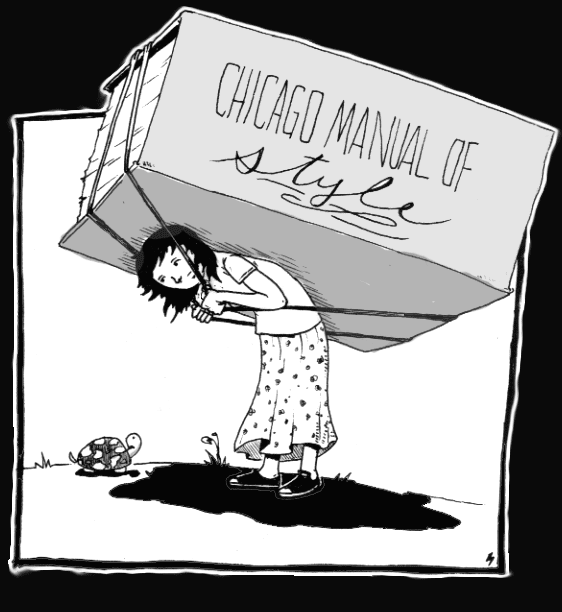
The Dananator Takes a Love-ah
Illustration by
Master Matt

Style has many contrasting qualities, much like an affair. It can be fabulous, tacky, impromptu, premeditated, tawdry, passionate, casual, and glamorous. It can begin with a wayward glance or a knowing smile or a simple sheet of paper. Case in point, the Chicago Manual of Style.

The Chicago Manual of Style started as a single sheet of paper. Someone (who was this creator, lost in the mists of obscurity?) bothered to make a list of basic typographical considerations and methods of citations to serve as an in-house style sheet specifically for the University of Chicago Press. In the beginning, it was a casual dalliance.

But somehow, subtly, it took hold and began to grow into a more solid, substantial romance. Slowly, word of it began to spread, and eventually its roots grew deep into university life and it branched out to become nationally and then internationally respected.

Now it sits on my desk, a venerable and stately tome. Or, a 984-page orange monstrosity cataloguing every nit and every pick that relates to any print or text or type that you can think of. Ah, The Chicago Manual of Style: a name that mentally drapes frothy layers of chiffon over some very hard edges. “Style,” you say? A manual of “style”? How lovely! Style is an individual thing, something that welcomes whimsy and combines creativity and panache. Interesting, then, that when I heave open The Chicago Manual of Style—CMS—I can also find style—that elusive, gossamer expression of individuality—pinned down like a chloroformed butterfly on a wax tray.

I’ve always had difficulty trying to teach my students writing “style,” either the analysis of the style of others, or the cultivation of their own. When I point out an example of a certain writer’s style, there is almost no way to explain how it is identifiable as such. Sure, I can tell them to look at word choices, sentence lengths, rhythm of language, cadence of dialogue, but ultimately, the example I have chosen is one instance of what one person decided to do with one particular language situation—never to be repeated.

But of course, one’s writing style does have a nuance, it leaves that taste it your mouth, drips with that je ne sais quoi. Really: je ne sais quoi. And if je ne sais, you can imagine what my students are thinking. Style is a certain way of moving, speaking, looking, doing, choosing—a certain way, but not necessarily a particular way, or the same way every time.

More maddening by far is trying to teach my students how to use The Chicago Manual of Style.

The inevitable protest: “But why? Why does the comma have to go there in my citation?” And from some of the more informed ones: “Ancient Greeks didn’t have punctuation. Are you telling me that Plato would have gotten a C on his bibliography?” Or: “Look at ee cummings and bell hooks—they did awright.”

I explain patiently, that we need consistency. We need all the sources cited in a universal format so they are immediately comprehensible to all.

“So if I put the page numbers before the publication date, it would become incomprehensible to you?”

Well, no. I guess that would be fine. Other things would also be fine. If you mix up ibid and the 3-em dash, the academy would survive. If your page range is indicated by a hyphen instead of an en dash, the ivory tower would not crumble.

Granted, it wouldn’t be good if bibliographies were composed in the style of e e cummings, but somehow I doubt it would come to that. So why the rigidity? Why has the CMS become such a colossus, so admired and yet so feared?

I believe a clue may lie in its nickname: The Bible. People use bibles to find hope. To receive comfort. To prove that they’re right. To condemn the deeds of others. To brush up against omnipotence and even, after much study, to claim it as theirs.

The nickname is eerily appropriate, although at times it does come up lacking. The CMS does not particularly inspire hope to students who have to compile a bibliography from a compost heap of books and papers at 4 AM after writing for 13 hours straight. Nor do its pages produce much comfort, even as an impromptu pillow.

But on a more general level, the nickname is right on. After all, it’s got chapters. And verses, of a sort. With its paper cover off, it even resembles a religious text. It’s only missing an embossed dove on its cover. In fact, it reminds me of the hymnal that was in the church I went to when I was a little girl. I can almost hear Father Kincade’s voice booming from the lectern: “Please open your CMS to page 302 and join us in singing ‘Hyphenation Guide For Compounds, Combining Forms, and Prefixes,’ verses 3 and 4.”

I do, in fact, think of the CMS as a sort of Catholic Church. It is demanding, exacting, exhausting, mostly unreasonable, and often ambiguous. There has even been a Schism. APA, AMA, MLA, and Turabian styles are all similar, competing style guides that were adapted from the original CMS.

Also, like the Catholic Church, the CMS has followers—some casual, some fanatics. It is tempting to look at the CMS and marvel at its infallibility, its utter ironclad correctness. If you sit very still in front of it you can feel a slight tug, such is its gravitas. I count myself among those too easily wooed by its 77-page index.

That is, until I heard about the Green Bay Packers. I recently took a course called Basic Manuscript Editing, which was all CMS, all the time. One night as I sat in class wide-eyed with indoctrination, our instructor mentioned in a humorous aside an example sentence in section 6.83 that featured the Green Bay Packers. She told us that the editor in charge of that section is a huge Green Bay fan, so he tried to include the Packers whenever he could in the examples.

What?

Had she just said that some guy had made up this example? And that this guy, whoever he was, edited only one section, implying that there were other unknown guys editing other sections, themselves gratuitously inserting other arbitrary sports teams?

I couldn’t fathom that there was a human being behind that example. Did it not just rise unbidden from the mists of omnipotence? Were its original letters not carefully scribed on crumbling papyrus now hidden in a clay jar at the back of some desert cave?

No, that example was not penned by the hand of the almighty, but by some guy. An editor at the University of Chicago. Someone not unwise, certainly, but who equally certainly did not send his seraphim to get him another cup of coffee or to run to Medici to pick up some lunch. Perhaps this man is slightly balding, with tortoiseshell rimmed glasses and a cracked front tooth. If he only knew my mental scrutiny, he would freeze immediately, or maybe make a flustered attempt to conceal his work, as did the little man behind the great Wizard of Oz.

But however he looks, he is a Green Bay fan. If he were a Dallas fan, the CMS would read differently.

We like our bibles set in stone, unyielding and universal in both their essentials and their particulars. We take comfort in making and referring to comprehensive guides to things that can never truly have comprehensive guides. Dr. Spock wrote a comprehensive guide to children, and consequently a generation was raised in a certain style. The style was not all bad, or all good. He advocated a certain pattern, one man’s way of handling a series of possible incidents, suggesting particular choices that can never truly imitated or repeated because they are each unique, like the children themselves.

Someone made a list of typographical considerations, and now thousands of students struggle to write in a certain style, twisting and contorting language until the very thoughts they are striving to articulate are lost, their uncertain beauty painted over by meaningless consistency.

Someone, or perhaps more accurately a group of guys, wrote something that was compiled into the book we now call the Bible, and now untold numbers of people live their lives in a certain style. This style is not all bad, or all good. It advocates rules to which nearly everything seems an exception. It strongly advises courses of action for situations that will never occur again, just so, in the modern world. Its nuances are interpreted in as many ways as there are readers. Yet people live and die—and kill—by it.

Some things shouldn’t have manuals, not because the manuals are bad but because we abuse them with our trust. Unfortunately, the manuals prone to this blend in with those that bear up much better under blind confidence. The manual for your Mac? Sure, tattoo it on your arm. It will never disappoint. The DVD instruction guide? Yes, by all means, organize your life by its precepts and you will never blink 12:00, 12:00, 12:00. The TIAA-Cref manual? Bow your head over its pages and search for the meaning of life therein, and your medical benefits will be none the worse for the wear. But manuals for children, language, or morality? These are the manuals that should come with a warning—maybe a Green Bay logo emblazoned across the cover.

Labels: ,


Read more!

Saturday, June 03, 2006

Meet the Dananator

Dananator (Day-nah-nay-tohr) is a post-collegiate, pre-professional twenty-something editor, writer, public intellectual living in Chicago's Lincoln Park district. A graduate of the Univ. of Chicago, Dana is JBB's resident expert on bad books, great Literature, Life plans, teaching philosophies, sheep and coffee. She enjoys reading, writing, but not arithmatic.

Labels:


Read more!

Friday, June 02, 2006

In Defense of Bad Books

The Dananator's
Read Everything Approach


It didn’t take me long to discover that, as a writer, Dan Brown lacks a certain grace. After all, this gem was located on page two of The Da Vinci Code: “‘You are lying.’ The man stared at him, perfectly immobile except for the glint in his ghostly eyes. ‘You and your brethren possess something that is not yours.’” Yet despite that last sentence and hundreds of others like it, Dan Brown possesses worldwide literary fame and a lot of money from selling 40 million copies of his novel. Unlike so many of his brethren, Brown has achieved what many an amateur novelist longs to do: publish a bestseller.

It’s common knowledge that bestsellers are not always the best books, and with greater fame and bigger book sales comes more intense scrutiny and criticism. The Da Vinci Code is certainly no exception. Although the book claims the somewhat dubious accolades of People, The Denver Post, Clive Cussler, and Nelson DeMille on its jacket, it has been widely panned by the critics for its sloppy writing, predictable plotline, dubious history, and academic affectations.

So why am I reading it? When I walked into Barnes and Noble last week and became Dan Brown’s forty-million-and-first customer, I set into motion a bold new plan for my personal reading habits. This new plan is entitled Read Everything. I used to try to have standards, choosing what I planned to read with great care, electing to read only things that would further my knowledge of literature and my facility with language. I would look askance at the woman standing next to me on the CTA, clinging to a pole with one hand and a copy of the latest Nicholas Sparks novel in the other. I, in contrast, was prepared to dive into the copy of Thomas Hardy’s Jude the Obscure that rested snugly in my backpack. Where it had been stowed away for the last three weeks.

Truthfully, I just wasn’t into it. I should have been, because Thomas Hardy— a canonical English novelist—wrote it, and after all, I did just get my Masters in Humanities with a concentration in literature, and after all, I was teaching literature to college students, so certainly it would behoove me to bury myself in Hardy’s literary stylings for personal and professional gain. However, with copies of the Red Eye being free these days, how could Jude the Obscure possibly compete?

It couldn’t. I found that the weighty, intellectually stimulating books I had elected to read were not, in fact, read but instead hauled around like dead weight. Something had to be done, and with all the discussion of The Da Vinci Code, I saw a chance to break free from my own restrictions and read a book that had “Coming Soon to the Big Screen!” printed in gold over a sunburst on its cover.

The seed of the Read Everything plan was planted when I began my new job in the publishing industry. Seeing books in various stages of readiness is like seeing relatives in various stages of undress—unsettling at best, traumatizing at worst.

When I was younger I used to have the utmost respect for books as physical objects. I used to put off the moment when I had to crease the binding of a new volume, sometimes reading at an awkward angle for chapters and chapters. I would never dog-ear the pages to remember where I had stopped reading. Of course, these prohibitions relaxed slightly as I got further in school and needed to underline and highlight texts, but I think my primordial respect for books was closely tied to their physical format at some deep subconscious level. These pages, I would think, hold Ideas and Concepts and Great Narratives worthy of being put into Print, a feat which only Real Writers achieved.

Now that many of my waking hours revolve around proofreading, page passes, InDesign snafus, and margin tweaking, I feel a bit like a medical student in anatomy lab. It must be tempting for future doctors, having grown used to the sight of cadavers opened up on tables, to see everyone as so much tissue and gristle. There they are, my beloved books, lying on sterile tables slit from belly to chin—all their typos and flaws exposed, the arbitrary nature of their composition evident to all.

Seeing books that way, on a devastatingly leveled playing field, did not so much topple my admiration for the great as it elevated my opinion of the mundane. It cannot be denied that there are both good and bad books. What I am no longer certain of is whether it is incumbent upon us to give a damn about which is which as we select what to read. I have decided to do away with my own vetting process in favor of a glorious free for all.

We need bad books. While the great books, the golden tomes that manage to articulate the human experience with shimming cascades of beautiful language, should be lauded, bad books should be equally revered because good readers, and good writers, would be lost without them. And so no longer will I sort my books according to their perceived “worth” or judged by their author’s skill. Rather, the crap books I own will stand proudly alongside the ones of far greater literary merit. They have earned their place there by being both entertaining and didactic.

Bad books are fun to read. Although the The Da Vinci Code has elicited a flinch or an eye-roll from me once every three or four pages, those pages keep turning—and they’re not turning themselves. A massive conspiracy handed down throughout the ages by a secret society, the inherent corruption of one of the world’s largest and most influential religions, a high-octane anxiety-filled international chase, an undercurrent of sexual tension—sure, I’ll read it. Beats looking out the window at the Dan Ryan on my commuter train at 7:30 every morning.

Popular books are popular because they entertain. The Da Vinci Code may not be airtight in its scholarship or flawless in its turn of phrase, but the story is cool. Raise your hand if you saw the first or third film in the Indiana Jones series (we’ll put the second aside for a moment for the purity of the argument). Keep them up if you thought your viewing of them was a waste of three hours of your life. That’s what I thought. The Da Vinci Code is Indiana Jones in modern-day Europe, except the female gets a more substantial role. I have my complaints, but generally, I dig it. Of course, I’m not going to send an application into the Priory of Scion, but it was a fun read and an interesting take on the Catholic Church.

Truly bad writing can even be raised to an art form. We honor it through our mockery. The Bulwer-Lytton Fiction Contest has been giving awards to the worst opening sentence in an imaginary novel every year since 1982. The winning sentences, while they almost always elicit groans, additionally elicit a pause from me in which I consider how truly entertaining bad writing can be. To wit, consider this entry from 2004 Grand Prize winner, Dave Zobel:

“She resolved to end the love affair with Ramon tonight . . . summarily, like Martha Stewart ripping the sand vein out of a shrimp’s tail . . . though the term “love affair” now struck her as a ridiculous euphemism . . . not unlike “sand vein,” which is after all an intestine, not a vein . . . and that tarry substance inside certainly isn’t sand . . . and that brought her back to Ramon.”


Bad books are also edifying. Every once in a while when I’m plowing my way through a paragraph that is awkward, ugly, or totally unjustifiable, I ask myself how I would fix it. I admit that I occasionally answer myself by saying “I wouldn’t include this godawful subplot in the first place” or even “By never being born,” but more often I identify with the author’s plight. Good writing is hard to do, and so I like to think that by providing fellow writers with a sympathetic reading even in the lowest, slimiest trenches of the written word, I will myself someday be the recipient of such generosity. Or at least, I’ll improve my own technique by trying to pull something redeeming out of the wreckage.

But beyond the personal skill level, bad writing can teaches us about ourselves and our world in a way that is just as valuable as those cracked open by greater scribes. When I was in school for my Masters degree I wrote a paper on fanfic. Those who have stumbled upon this phenomenon know the horror that awaits you at websites such as lotr.net or harrypotterfanfiction.com. They consist of colonies of amateur writers who are very passionate about a particular television show, movie, or series of books. Their passion moves them to write stories using the characters and context of their original inspiration. And some of it is bad. Very, very bad. Here’s a typical summary:

“My story takes place when Arwen is 15. It begins in Rivendell, but somehow Arwen’s path will lead her to a typical American high school where she has fallen in love with the mortal boy who sits next to her in trigonometry.”

When I was researching this paper my reading experience was often similar to depilation, but just as often I was left with a small kernel of empathy and goodwill for these intrepid writers. After all, if only unwittingly, they have allowed us to see into some of the most intimate situations and challenging problems of their lives to date. The author above is clearly using writing to lessen the sting of an unrequited math class crush. It may not sound like Shakespeare, but she’s using writing to reach out and connect with others through her own pain—an instinct I think the bard would approve of.

The Da Vinci Code is doing the same thing, but for our entire society. To capture the imagination of so many, Dan Brown evidently has plucked a few resounding chords on the heartstrings of his massive readership. It’s easy to extrapolate how years of pent-up resentment at the Catholic church, and a growing willingness to reconsider women’s inferior place in most spiritual disciplines are attractive emotional veins to tap.

Finally, because of their popularity, bad books reflect our period in history in the way that no timeless classic can. The stalwarts of the Canon are not as useful as reality television, entertainment tabloids and, yes, popular novels in defining and characterizing our particular cultural moment. Perhaps having your finger on the pulse of the culture, especially pop culture, isn’t important to some, but it is to me. When I’m old I want to be a relic of my epoch. I want to make my grandchildren roll their eyes when I begin making book and movie recommendations five decades or so out of date. I want to know what’s going on now, so that when now is over, I’ll know what happened.

This all reminds me of Emile, a book by Rousseau proposing a method of education to bring about an ideal citizen. The crucial part of his plan was the first couple of decades of the child’s life, when he was to live a relatively isolated existence in the countryside, reading only carefully chosen books to promote the utmost mental and moral development.

Game over. I spent my first decade reading, ravenously, avidly, anything I could get my hands on, from a copy of my dad’s Esquire magazine to The Babysitters’ Club #173. My second decade was less productive because I spent it trying to read books I didn’t and couldn’t possibly understand. I knew that by selecting texts off the shelf labeled Literature in Waldenbooks I could impress teachers and relatives, but although my 13-year-old eyes traveled carefully over every word of Madame Bovary, they did so in vain. I had no way to truly connect with what I was reading. And so now I would gladly leave Emile to his empty countryside and pile of Signet Classics in favor of an utterly unfettered smorgasbord of reading.

The biggest flaw in my Read Everything plan is my eventual death. I’m hoping I have a few good years left, but after those I will have to move on, and I don’t know how many books I’ll be able to take with me (or how much time I’ll have to read them). So should I really be investing this precious remaining time reading any old supermarket claptrap? Shouldn’t I be desperately cramming my brain with only the choicest nuggets that literature has to offer?

I don’t intend to abolish “good” books from my life, or from my commute. Rather, I plan to choose what to read by…(drumroll)…reading what interests me, whether that book is generally considered good, bad, or indifferent. I plan to continue reading said book only as long as it continues to interest me, after which I will toss it aside lightly, or should the situation arise, I will do as Dorothy Parkers suggests and throw it aside with great force.

For a while, anyway. If I turn into a drooling moron, maybe I’ll blow the dust off the cover of my copy of Anna Karenina and get cracking. But otherwise, you’ll find me forging deeper into my brave new world in the Fiction section of Waldenbooks, hunting down a copy of The Devil Wears Prada.

Labels:


Read more!